 01-28-2015
|
#121
|
Join Date: Mar 2006
Location: Minnesota
Drives: Cars
Posts: 1,457
|
Re: Possibly the most retarded anti-gun ad I've ever seen...
Quote:
Originally Posted by tehehodi

I still think the ad is pretty retarded
|
Lol
__________________
-Matt
'94 Eagle Talon TSI AWD
'06 Acura TL
|

|

|
|
01-28-2015
|
#122
|
|
Admin
Join Date: Oct 2003
Location: Sportsman's Paradise, LA.
Posts: 5,382
|
Re: Possibly the most retarded anti-gun ad I've ever seen...
Quote:
Originally Posted by Halon
The right to bear arms is a "right". Having a drivers license is a privilege. Those are two very different things.
|
+1
__________________
"You don't have a clue. You couldn't get a clue during the clue mating season in a field full of horny clues if you smeared your body with clue musk and did the clue mating dance."
When she get's bitchy, SPANK THAT ASS! (#Y#)
|
|
|
|
|
01-28-2015
|
#123
|
|
Admin
Join Date: Oct 2003
Location: Sportsman's Paradise, LA.
Posts: 5,382
|
Re: Possibly the most retarded anti-gun ad I've ever seen...
Quote:
Originally Posted by jeremy1375
A well regulated militia being necessary to the security of a free state, the right of the people to keep and bear arms shall not be infringed.
It is a right, based on the foundation that a well regulated militia is necessary to the security of a free state, no?
If a well regulated militia doesn't require any type of training, what does it mean to be a well regulated militia?
|
Here's your answer:
"The Second Amendment to the United States Constitution states: "A well regulated Militia, being necessary to the security of a free State, the right of the people to keep and bear Arms, shall not be infringed." The reference to a "well regulated" militia, probably conjures up a connotation at odds with the meaning intended by the Framers. In today's English, the term "well regulated" probably implies heavy and intense government regulation. However, that conclusion is erroneous.
The words "well regulated" had a far different meaning at the time the Second Amendment was drafted. In the context of the Constitution's provisions for Congressional power over certain aspects of the militia, and in the context of the Framers' definition of "militia," government regulation was not the intended meaning. Rather, the term meant only what it says, that the necessary militia be well regulated, but not by the national government.
As Noah Webster put it in a pamphlet urging ratification of the Constitution, "Before a standing army can rule, the people must be disarmed; as they are in almost every kingdom in Europe." George Mason remarked to his Virginia delegates regarding the colonies' recent experience with Britain, in which the Monarch's goal had been "to disarm the people; that [that] . . . was the best and most effectual way to enslave them." A widely reprinted article by Tench Coxe, an ally and correspondent of James Madison, described the Second Amendment's overriding goal as a check upon the national government's standing army: As civil rulers, not having their duty to the people duly before them, may attempt to tyrannize, and as the military forces which must be occasionally raised to defend our country, might pervert their power to the injury of their fellow citizens, the people are confirmed by the next article in their right to keep and bear their private arms.
Thus, the well regulated militia necessary to the security of a free state was a militia that might someday fight against a standing army raised and supported by a tyrannical national government. Obviously, for that reason, the Framers did not say "A Militia well regulated by the Congress, being necessary to the security of a free State" -- because a militia so regulated might not be separate enough from, or free enough from, the national government, in the sense of both physical and operational control, to preserve the "security of a free State."
http://www.lectlaw.com/files/gun01.htm
__________________
"You don't have a clue. You couldn't get a clue during the clue mating season in a field full of horny clues if you smeared your body with clue musk and did the clue mating dance."
When she get's bitchy, SPANK THAT ASS! (#Y#)
Last edited by 1ViciousGSX; 01-28-2015 at 10:00 AM..
|
|
|
|
|
01-28-2015
|
#124
|
Join Date: Dec 2012
Location: Lindstrom
Drives: 1990 Eagle Talon Tsi AWD
Posts: 347
|
Re: Possibly the most retarded anti-gun ad I've ever seen...
I understand what you are saying here. But this is the point I was trying to bring up before " that the necessary militia be well regulated, but not by the national government."
If it needs to be well regulated, just not by the national government, who is left but the state government?
You argued that the case I pulled up before was interpreted to intentionally manipulate the 2nd amendment to something they wanted it to mean, but knew it didn't mean.
In Barron v. Baltimore in 1833, writing for a unanimous court, Chief Justice John Marshall held that the first ten "amendments contain no expression indicating an intention to apply them to the State governments. This court cannot so apply them."
That case should make it pretty clear that there was no implied intention whatsoever to apply the Bill of Rights to states when it was written. A unanimous ruling is a good indication that there was no controversy in the decision. The Bill of Rights was undoubtedly written to restrict national power, not state power.
This is how militia was defined in "A Dictionary Of The English Language" published in 1756
https://play.google.com/store/books/...d=fcVEAAAAcAAJ
MILITIA. f. [Latin.] The trainbands ; the standing force of a nation.
TRAINBANDS. / The militia ; the part of a community trained to martial exercise.
That was how it was defined when the constitution was written. The militia were the trainbands who were the part of the community. They were trained.
Last edited by jeremy1375; 01-28-2015 at 11:18 AM..
|
|
|
|
|
01-28-2015
|
#125
|
|
Admin
Join Date: Oct 2003
Location: Sportsman's Paradise, LA.
Posts: 5,382
|
Re: Possibly the most retarded anti-gun ad I've ever seen...
Once again, for those of us who must be a little slow.
The Bill of Rights was written to protect the individua'ls rights, PERIOD. The fact that it does not specifically say "You too states, hands off" is irrelevent, it doesn't have to. The Bill of Rights is the supreme document that protects your rights from any form of government intrusion, federal or state, doesn't matter.
__________________
"You don't have a clue. You couldn't get a clue during the clue mating season in a field full of horny clues if you smeared your body with clue musk and did the clue mating dance."
When she get's bitchy, SPANK THAT ASS! (#Y#)
|
|
|
|
|
01-28-2015
|
#126
|
Join Date: Dec 2012
Location: Lindstrom
Drives: 1990 Eagle Talon Tsi AWD
Posts: 347
|
Re: Possibly the most retarded anti-gun ad I've ever seen...
Quote:
Originally Posted by 1ViciousGSX
The Bill of Rights was written to protect the individua'ls rights, PERIOD. The fact that it does not specifically say "You too states, hands off" is irrelevent, it doesn't have to. The Bill of Rights is the supreme document that protects your rights from any form of government intrusion, federal or state, doesn't matter.
|
The Bill of Rights was written to protect states, local and person rights from the federal government. PERIOD.
Quote:
Originally Posted by 1ViciousGSX
Once again, for those of us who must be a little slow.
|
Do some more research, and you'll see what I mean.
In the context of history, the 2nd amendment means this.
The federal government understands that a well regulated militia is important to the security of a free state. We understand there is some concern about the reach of this national government due to our experiences with England and other countries. If your state chooses to have a well regulated militia, we understand why and this amendment guarantees the federal government will not infringe on the rights of your state or locality to do so.
The 10th amendment makes explicit our dual federalism structure "The powers not delegated to the United States by the Constitution, nor prohibited by it to the States, are reserved to the States respectively, or to the people."
If all of this is wrong, calling me slow isn't going to help. Prove me wrong with historical fact. The concept that the The Bill of Rights was written to protect the individuals rights simply isn't true. That notion that the bill of rights should apply to individuals wasn't brought forth until the 14th amendment in 1868.
Context is everything if we're going to argue what the founding fathers meant the bill of rights to be.
Last edited by jeremy1375; 01-28-2015 at 02:15 PM..
|
|
|
|
|
01-28-2015
|
#127
|
|
Admin
Join Date: Oct 2003
Location: Sportsman's Paradise, LA.
Posts: 5,382
|
Re: Possibly the most retarded anti-gun ad I've ever seen...
The Fourteenth Amendment dealt with applying rights to the recently relased slaves. It gave them the same right we have.
Fourteenth Amendment
The Fourteenth Amendment to the U. S. Constitution reads:
Section 1. All persons born or naturalized in the United States, and subject to the jurisdiction thereof, are citizens of the United States and of the State wherein they reside. No State shall make or enforce any law which shall abridge the privileges or immunities of citizens of the United States; nor shall any State deprive any person of life, liberty, or property, without due process of law; nor deny to any person within its jurisdiction the equal protection of the laws."
Section 2. Representatives shall be apportioned among the several States according to their respective numbers, counting the whole number of persons in each State, excluding Indians not taxed. But when the right to vote at any election for the choice of electors for President and Vice President of the United States, Representatives in Congress, the Executive and Judicial officers of a State, or the members of the Legislature thereof, is denied to any of the male inhabitants of such State, being twenty-one years of age, and citizens of the United States, or in any way abridged, except for participation in rebellion, or other crime, the basis of representation therein shall be reduced in the proportion which the number of such male citizens shall bear to the whole number of male citizens twenty-one years of age in such State."
Section 3. No person shall be a Senator or Representative in Congress, or elector of President and Vice President, or hold any office, civil or military, under the United States, or under any State, who, having previously taken an oath, as a member of Congress, or as an officer of the United States, or as a member of any State legislature, or as an executive or judicial officer of any State, to support the Constitution of the United States, shall have engaged in insurrection or rebellion against the same, or given aid or comfort to the enemies thereof. But Congress may by a vote of two-thirds of each House, remove such disability."
Section 4. The validity of the public debt of the United States, authorized by law, including debts incurred for payment of pensions and bounties for services in suppressing insurrection or rebellion, shall not be questioned. But neither the United States nor any State shall assume or pay any debt or obligation incurred in aid of insurrection or rebellion against the United States, or any claim for the loss or emancipation of any slave; but all such debts, obligations and claims shall be held illegal and void."
Section 5. The Congress shall have power to enforce, by appropriate legislation, the provisions of this article."
The Fourteenth Amendment, ratified in 1868, has generated more lawsuits than any other provision of the U.S. Constitution. Section 1 of the amendment has been the centerpiece of most of this litigation. It makes "All persons born or naturalized in the United States"citizens of the United States and citizens of the state in which they reside. This section also prohibits state governments from denying persons within their jurisdiction the privileges or immunities of U.S. citizenship, and guarantees to every such person due process and equal protection of the laws. The Supreme Court has ruled that any state law that abridges Freedom of Speech, freedom of religion, the right to trial by jury, the Right to Counsel, the right against Self-Incrimination, the right against unreasonable searches and seizures, or the right against cruel and unusual punishments will be invalidated under section 1 of the Fourteenth Amendment. This holding is called the Incorporation Doctrine.
Sections 2 to 5 have been the subject of far fewer lawsuits. Some of these sections seem anachronistic today because they reflect the immediate concerns of the Union's political leadership following the North's victory over the South in the Civil War (1861–65). Section 2, for example, penalized any state that attempted to abridge the voting rights of its black male residents by reducing the state's representation in Congress (no female resident of any race was afforded the constitutional right to vote in the United States until 1920). Section 3 prohibited from holding state or federal office any person who engaged in "insurrection or rebellion" or otherwise gave "aid or comfort to the enemies" during the Civil War. Section 4 reaffirmed the United States' commitment to pay its Civil War debt, while declaring all debts and obligations incurred by the Confederate government "illegal and void." Section 5 enabled, and continues to enable, Congress to pass "appropriate legislation" to enforce the provisions of the Fourteenth Amendment.
The Fourteenth Amendment was drafted to alleviate several concerns harbored by many U.S. citizens prior to its ratification. The most obvious concern related to the status of the recently freed slaves. Five years before hostilities commenced in the Civil War, the Supreme Court declared that people of African descent living in the United States were not "citizens" of the United States, but merely members of a "subordinate and inferior class of human beings" deserving no constitutional protection whatsoever (dred scott v. sandford, 60 U.S. [19 How.] 393, 15 L. Ed. 691 [1856]). The Fourteenth Amendment vitiated the Supreme Court's holding in Dred Scott by making all blacks "born or naturalized in the United States" full-fledged citizens entitled to the same constitutional rights provided for every other U.S. citizen.
The racist attitudes expressed in Dred Scott also manifested themselves after the Civil War. In 1865, the southern states began enacting the Black Codes, which deprived African Americans of many basic rights afforded to white Americans, including the right to travel, bear arms, own property, make contracts, peaceably assemble, and testify in court. The Black Codes also authorized more severe punishments for African Americans than would be imposed on white persons for committing the same criminal offense. The Fourteenth Amendment offered an antidote to these discriminatory laws by guaranteeing to members of all races "due process of law," which requires the legal system to provide fundamentally fair trial procedures, and "equal protection of the laws," which requires the government to treat all persons with equal concern and respect.
Dred Scott was not the only Supreme Court decision that influenced the framers of the Fourteenth Amendment. Barron v. City of Baltimore, 32 U.S. (7 Pet.) 243, 8 L. Ed. 672 (1833), also played a significant role. This case involved a Maryland wharf owner who brought a lawsuit against the city of Baltimore for violating the Fifth Amendment's eminent domain clause, which prohibits the government from taking private property without "just compensation." Baltimore defended against the wharf owner's lawsuit by arguing that the Fifth Amendment only provides relief against action taken by the federal government and offers no protection against state governments or their political subdivisions. The Supreme Court agreed with Baltimore.
Writing for the Court, Chief Justice John Marshall asserted that the Constitution created the federal government, and the provisions of the Constitution were designed to regulate the activity of the federal government. The people of each state enacted their own constitution, Marshall contended, to regulate the activities of their state and local governments. Thus, Marshall reasoned that the U.S. Constitution operates only as a limitation on the powers of the federal government, unless one of its provisions expressly restricts the powers of state governments, as does Article I, Section 10.
Article I, Section 10, provides that "[n]o State shall enter into any Treaty, Alliance, or Confederation," or "pass any Bill of Attainder, ex post facto law, or Law impairing the Obligation of Contracts." This wording, Marshall maintained, demonstrates that the Framers understood the type of clear and unequivocal language that must be used to make a provision of the federal Constitution binding on the states. Because the first eight amendments to the Constitution do not contain language that restricts the powers of state governments, Marshall concluded that the Bill of Rights was inapplicable to the states.
The Supreme Court's decision in Barron weighed heavily on the mind of john bingham, the Republican representative from Ohio who was the primary architect of Section 1 of the Fourteenth Amendment. Bingham said he "noted … certain words in the opinion of Marshall" when he was "reexamining that case of Barron." The chief justice, Bingham stressed, denied the wharf owner's claim because the Framers of the Bill of Rights, unlike the Framers of Article I, Section 10, had not chosen the type of explicit language that would clearly make the Bill of Rights applicable to state governments. "Acting upon" Marshall's "suggestion" in Barron, Bingham said, he "imitated"the Framers of Article I, Section 10:"As [these Framers had written] 'no state shall … pass any Bill of Attainder …' I prepared the provision of the first section of the fourteenth amendment."
Bingham's remarks shed light on the Supreme Court's decision to make most of the provisions contained in the Bill of Rights applicable to state governments through the doctrine of incorporation. Under this doctrine, the Supreme Court has ruled that every protection contained in the Bill of Rights—except for the right to bear arms, the right to indictment by Grand Jury, the right to trial by jury in civil cases, and the right against quartering soldiers—must be protected by state governments under the Equal Protection and Due Process Clauses of the Fourteenth Amendment.
The Supreme Court has explained that each of these incorporated rights is "deeply rooted in the nation's history" and "fundamental" to the concept of "ordered liberty" represented by the Due Process Clause (Palko v. Connecticut, 302U.S. 319, 58 S. Ct. 149, 82 L. Ed. 288 [1937]). Any state that denies one of these rights is violating its duty to provide the "equal protection of the laws" guaranteed to the residents of every state by the Fourteenth Amendment.
Although a state may provide more constitutional protection to its residents than is conferred by the Bill of Rights, the Fourteenth Amendment prohibits any state from providing less protection. For example, the Supreme Court upheld the constitutionality of sobriety checkpoints, which authorize police officers to stop motor vehicles to determine if the driver has been consuming alcohol, regardless of whether the stop was based on Probable Cause or made pursuant to a Search Warrant as required by the Fourth Amendment (Michigan v. Sitz, 496U.S. 444, 110 S. Ct. 2481, 110 L. Ed. 2d 412[1990]). The Minnesota Supreme Court reached the opposite conclusion, invalidating arrests made during traffic stops at sobriety checkpoints because they did not comport with the state's constitutional provisions prohibiting unreasonable searches and seizures (Ascher v. Commissioner of Public Safety, 519 N.W.2d 183 [Minn. 1993]).
Whereas the Due Process and Equal Protection Clauses have given rise to a panorama of legal claims such as the sobriety checkpoint cases, the privileges and immunities clause has produced only a few lawsuits since the end of the 1800s. Like most other legal terms in the Bill of Rights, the phrase privileges or immunities is not defined in the Constitution. Nor does the phrase possess a meaning that is self-evident. However, some insight into the meaning of the Privileges and Immunities Clause may be gleaned from statements made by the man who drafted it, Congressman Bingham.
Bingham said the "privileges and immunities of citizens of the United States … are chiefly defined in the first eight amendments to the Constitution of the United States… . These eightarticles … never were limitations upon the power of the states until made so by the Fourteenth Amendment" (quoted in Adamson v. California, 332 U.S. 46, 67 S. Ct. 1672, 91 L. Ed. 1903[1947] [Murphy, J., dissenting]). Senator Jacob Howard echoed these thoughts, stating that "these privileges and immunities, whatever they may be—for they are not and cannot be fully defined in their entire extent and precise nature—[include] … personal rights … such as the freedom of speech and of the press, [and] the right of the people to peaceably assemble and petition the government for redress of grievances." Similarly, Representative James Wilson made it clear that the "privileges and immunities of the citizens of the United States" include "[f]reedom of religious opinion" and "freedom of speech and press."
Notwithstanding the statements made by these congressmen, the Supreme Court has limited the application of the Fourteenth Amendment's Privileges and Immunities Clause to provide only negligible protection against the state and federal governments. In the Slaughter-House Cases, 83 U.S. (16 Wall.) 16, 21 L. Ed. 268 (1873), a group of New Orleans butchers brought a lawsuit to invalidate a Louisiana law that granted a Monopoly to a local slaughterhouse. The butchers alleged that the state-chartered monopoly violated their "privileges and immunities" to pursue gainful employment free from unlawful restraints.
In an extremely narrow reading of the Fourteenth Amendment, the Supreme Court rejected the butchers' argument. The Court held that the Privileges and Immunities Clause protects only rights derived from U.S. citizenship, such as the right to Habeas Corpus and interstate travel and not rights derived from state law, such as the common-law rights of tort and property asserted by the New Orleans butchers. The Supreme Court has neither overruled its decision in the Slaughter-House cases nor expanded its narrow interpretation of the Privileges and Immunities Clause. Most constitutional scholars have since pronounced this clause a dead letter.
If the Supreme Court has provided a more conservative interpretation of the Privileges and Immunities Clause than envisioned by the Framers of the Fourteenth Amendment, it has provided a more liberal interpretation of the Equal Protection Clause. In brown v. board of education, 347 U.S. 483, 74 S. Ct. 686, 98 L. Ed. 873 (1954), the Supreme Court ruled that the doctrine of "separate but equal," in which the black and white races were segregated in public schools and other places of public accommodation, was "inherently unequal" and denied African Americans "equal protection of the laws." The ambit of the Equal Protection Clause was later enlarged by the Supreme Court beyond racial Segregation to cover an assortment of gender discrimination claims asserted by women.
The Court made these rulings in spite of evidence that racial segregation was prevalent at the time the Fourteenth Amendment was adopted and that women were treated like second-class citizens during most of the nineteenth century. In 1868, for example, racial segregation of public schools was permitted throughout the South and in eight northern states. The gallery of the U.S. Senate was itself segregated by race during the debate of the Equal Protection Clause. During the first half of the nineteenth century, every state proscribed married women from devising a will, owning or inheriting property, entering into a contract, or exercising almost any other basic civil right afforded to women in the modern United States. Indeed, the Common Law recognized no existence for married women independent from their husbands. By marriage, the Husband and Wife became one person in law, and that person was the husband.
Thus, the Framers' original understanding of the Fourteenth Amendment has not provided a useful yardstick to measure the Supreme Court's interpretation of the Due Process and Equal Protection Clauses. Since the mid-1940s, the Supreme Court has strayed further from the Framers' original understanding, recognizing controversial privacy rights to use contraceptives (griswold v. connecticut, 381 U.S. 479, 85 S. Ct. 1678, 14 L. Ed. 2d 510 [1965]), obtain abortions prior to the third trimester of pregnancy (roe v. wade, 410 U.S. 113, 93 S. Ct. 705, 35 L. Ed. 2d 147 [1973]), and view obscene pornographic material in the privacy of one's own home (Stanley v. Georgia, 394 U.S. 557, 89 S. Ct. 1243, 22 L. Ed. 2d 542 [1969]). In 1996 the Supreme Court held that the Equal Protection Clause had been violated by an amendment to the Colorado constitution prohibiting legislative, judicial, or executive action at the state or local level from protecting homosexual persons from discrimination in romer v. evans, 517 U.S. 620, 116 S. Ct. 1620, 134 L. Ed. 2d 855 (1996).
The Supreme Court has extended the reach of the Fourteenth Amendment to private actors when they become so entwined with state or local government that they become, in effect, state actors. In Brentwood Academy v. Tennessee Secondary School Athletic Association, 531 U.S. 288, 121 S.Ct. 924, 148 L.Ed.2d 807 (2001), the Court held that a state athletic association was so closely connected with the public schools as to become a state actor. The association sought to curtail the alleged football recruiting abuses of Brentwood Academy, a private school with a very successful football program.
Brentwood Academy sued the association and alleged that it had violated the Fourteenth Amendment. The association was not a part of state government, but the Supreme Court held that the state had delegated authority to regulate school athletic programs to the organization. The Court applied the general principle where there is such a "close nexus between the State and the challenged action," seemingly private behavior "may be fairly treated as that of the State itself."
http://legal-dictionary.thefreedicti...enth+Amendment
__________________
"You don't have a clue. You couldn't get a clue during the clue mating season in a field full of horny clues if you smeared your body with clue musk and did the clue mating dance."
When she get's bitchy, SPANK THAT ASS! (#Y#)
|
|
|
|
|
01-28-2015
|
#128
|
Join Date: Dec 2012
Location: Lindstrom
Drives: 1990 Eagle Talon Tsi AWD
Posts: 347
|
Re: Possibly the most retarded anti-gun ad I've ever seen...
|
|
|
|
|
01-28-2015
|
#129
|
|
Is funding Exxon.
Join Date: Oct 2003
Location: Ham Lake
Drives: like a bat outta hell!
Posts: 7,983
|
Re: Possibly the most retarded anti-gun ad I've ever seen...
Quote:
Originally Posted by jeremy1375
I understand what you are saying here. But this is the point I was trying to bring up before " that the necessary militia be well regulated, but not by the national government."
|
You seem to be getting hung up on the "well regulated" portion. Please go look and see what well regulated meant at their time. The militia was made up of farm boys that were called up THEN they were trained, not before. They also used their own guns, hence the reason for the 2nd amendment to talk about both things. They were not talking about an organized militia being able to have guns, it is the people that would potentially make up that militia. Basically they wanted the people to be able to fight back if the government became oppressive.
__________________
Is burning corn and stayin' warm!
My motorcycle is stock and reliable, my Talon is neither!
|
|
|
|
|
01-28-2015
|
#130
|
Join Date: Dec 2012
Location: Lindstrom
Drives: 1990 Eagle Talon Tsi AWD
Posts: 347
|
Re: Possibly the most retarded anti-gun ad I've ever seen...
Quote:
Originally Posted by JET
You seem to be getting hung up on the "well regulated" portion. Please go look and see what well regulated meant at their time. The militia was made up of farm boys that were called up THEN they were trained, not before. They also used their own guns, hence the reason for the 2nd amendment to talk about both things. They were not talking about an organized militia being able to have guns, it is the people that would potentially make up that militia. Basically they wanted the people to be able to fight back if the government became oppressive.
|
I've probably overstated the well regulated point a bit. Maintaining good focus on this discussion is hard. I'm trying to remain as objective and level headed as possible while being emotionally driven. Ultimately I want to end up understanding the truth of the matter whether I'm right or not. That's what's most important to me.
I do believe we are finally getting down to the heart of the matter though with the issue of whether the bill of rights were initially meant as a declaration of individual rights, trumping all other forms of government or just for restricting the federal government. All evidence I've found suggests the latter and that has big implications on the interpretation of the 2nd. This is all information I've come across while researching for posting on this thread and is all new to me, so I'm not defending a long held position here. |
|
|
|
|
01-28-2015
|
#131
|
|
Admin
Join Date: Oct 2003
Location: Sportsman's Paradise, LA.
Posts: 5,382
|
Re: Possibly the most retarded anti-gun ad I've ever seen...
The best part of all this is that we're talking about it. Most of the people don't know or don't care and that is a huge problem for this country.
Sure we might have the biggest, baddest military, but it's spread really thin right now around the world leaving us somewhat vunerable. Could having a highly armed populous be the deterent from a true military conflit on our soil?
I still stand with my belief that the Bill of Rights is about you and me and what the government can not do, whether state or federal. The 2nd amendment is so clear and simple there is nothing to interpret. And it was written that way on purpose, clear and concise.
__________________
"You don't have a clue. You couldn't get a clue during the clue mating season in a field full of horny clues if you smeared your body with clue musk and did the clue mating dance."
When she get's bitchy, SPANK THAT ASS! (#Y#)
|
|
|
|
|
01-28-2015
|
#132
|
|
Area code 166 represent
Join Date: Aug 2003
Location: Crystal, MN
Posts: 10,329
|
Re: Possibly the most retarded anti-gun ad I've ever seen...
Is this the thread where I ask for reviews on a product?

to drum or not to drum... hmmm
__________________
'16 Focus ST - Daily Duty
'93 mr2 - Track car in progress
|
|
|
|
|
01-28-2015
|
#133
|
Join Date: Dec 2012
Location: Lindstrom
Drives: 1990 Eagle Talon Tsi AWD
Posts: 347
|
Re: Possibly the most retarded anti-gun ad I've ever seen...
Quote:
Originally Posted by 1ViciousGSX
The best part of all this is that we're talking about it. Most of the people don't know or don't care and that is a huge problem for this country.
Sure we might have the biggest, baddest military, but it's spread really thin right now around the world leaving us somewhat vunerable. Could having a highly armed populous be the deterent from a true military conflit on our soil?
I still stand with my belief that the Bill of Rights is about you and me and what the government can not do, whether state or federal. The 2nd amendment is so clear and simple there is nothing to interpret. And it was written that way on purpose, clear and concise.
|
Even if we don't agree on anything else, I do agree that talking about it is a good thing. It's easy to get caught up in the ultra-polarized political rhetoric these days. There seems to be so much mistrust between the two sides and that can make it hard to relate to the people on the other side.
When it comes to our military, and as much money as we spend on it, we better be able to handle everything and more that the world throws at us without any help from the public. If not, we are not very good at budgeting. lol

As far as the origins of the bill of rights and 2nd, I can agree to disagree on that one. I respect your view of it. I grew up in a conservative family, but we never had guns so it wasn't much of a concern with my belief system when I identified as a conservative. Now I just try to remain fair minded and follow what I believe are the facts. |
|
|
|
|
01-28-2015
|
#134
|
Join Date: Dec 2012
Location: Lindstrom
Drives: 1990 Eagle Talon Tsi AWD
Posts: 347
|
Re: Possibly the most retarded anti-gun ad I've ever seen...
Quote:
Originally Posted by AJ
Is this the thread where I ask for reviews on a product?
to drum or not to drum... hmmm |
One star - Doesn't holster well. |
|
|
|
|
01-28-2015
|
#135
|
|
Area code 166 represent
Join Date: Aug 2003
Location: Crystal, MN
Posts: 10,329
|
Re: Possibly the most retarded anti-gun ad I've ever seen...
good point, concealing that would be a pain.
__________________
'16 Focus ST - Daily Duty
'93 mr2 - Track car in progress
|
|
|
|
|
01-28-2015
|
#136
|
|
Admin
Join Date: Oct 2003
Location: Sportsman's Paradise, LA.
Posts: 5,382
|
Re: Possibly the most retarded anti-gun ad I've ever seen...
Quote:
Originally Posted by AJ
good point, concealing that would be a pain.
|
But who would want too? talk about a deterrent.
__________________
"You don't have a clue. You couldn't get a clue during the clue mating season in a field full of horny clues if you smeared your body with clue musk and did the clue mating dance."
When she get's bitchy, SPANK THAT ASS! (#Y#)
|
|
|
|
|
01-28-2015
|
#137
|
|
Smells like cat poop
Join Date: Feb 2007
Location: maple grove
Drives: an evo's fat korean cousin
Posts: 2,549
|
Re: Possibly the most retarded anti-gun ad I've ever seen...
Has anyone read through this entire thread and had their minds changed about guns, gun control, gun ownership?
Or have these two debated enough to the point where you want to change the channel?
__________________
Speaking about wanting kids...
turbotalon1g: 3 max, she wants one of each.
A////guy: "we are shooting for a transgender child this time"
|
|
|
|
|
01-29-2015
|
#138
|
|
Crash Course Racing
Join Date: Oct 2003
Location: Skid Row
Drives: in circles
Posts: 2,623
|
Re: Possibly the most retarded anti-gun ad I've ever seen...
Quote:
Originally Posted by polishmafia
Has anyone read through this entire thread and had their minds changed about guns, gun control, gun ownership?
|
Yes, several times... In fact, I'm just patiently waiting for a gun buy back program so these guns of mine don't crawl out of the safe and harm me or my family
But seriously. Your flip flop question reminded me of this Sunny episode
http://www.hulu.com/watch/708244
__________________
What the fuck should I 4G6x swap?
Last edited by 1QUICK4; 01-29-2015 at 12:25 AM..
|
|
|
|
|
01-29-2015
|
#139
|
Join Date: Mar 2006
Location: Minnesota
Drives: Cars
Posts: 1,457
|
Re: Possibly the most retarded anti-gun ad I've ever seen...
Quote:
Originally Posted by AJ
Is this the thread where I ask for reviews on a product?
to drum or not to drum... hmmm
|
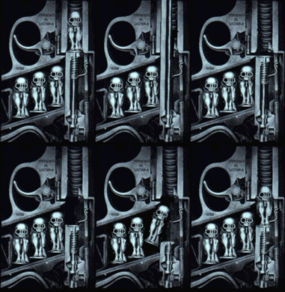
Or this for the fans of revolvers
__________________
-Matt
'94 Eagle Talon TSI AWD
'06 Acura TL
|
|
|
|
|
01-29-2015
|
#140
|
|
|
Re: Possibly the most retarded anti-gun ad I've ever seen...
Quote:
Originally Posted by polishmafia
Has anyone read through this entire thread and had their minds changed about guns, gun control, gun ownership?
Or have these two debated enough to the point where you want to change the channel?
|
I have definitely changed my position. I am now a vegan and will be melting down my guns in resistance! |
|
|
|
 Posting Rules
|
You may not post new threads
You may not post replies
You may not post attachments
You may not edit your posts
HTML code is Off
|
|
|
|
|










 Bloody Seal Bounce Champion!
 Linear Mode
